The Home Office has promised a law and a watchdog for police facial recognition. How live camera vans work now, what courts have said, and where Clearview stands.
- What is the new UK law on police facial recognition?
- On 4 November 2026, the Home Office said police use of facial recognition will get its own law, with an independent watchdog that can stop forces using it and a statutory code of practice. There is no bill text or start date yet. Until then, police rely on existing law and court rulings.
As of 13 November 2026, police facial recognition in UK law rests on court rulings and force policies, not a statute written for it. The Home Office announcement of 4 November 2026 sets out to change that.
What did the UK government announce?
Home Secretary Shabana Mahmood said "a specific law will be introduced". The Home Office release lists the plan:
- A new independent watchdog that sets standards and, in extreme cases, can seek a court injunction to stop a force using the technology.
- Independent testing of police systems for bias based on age, gender or race.
- Use that is intelligence-led and proportionate, only where officers believe wanted people could be in the area.
- A legal code for police, and a separate one for businesses such as shops.
The consultation response counts 13,845 responses but names no bill and no date.
The release also promises £11 million to triple the number of camera vans.
How is live facial recognition used in the UK today?
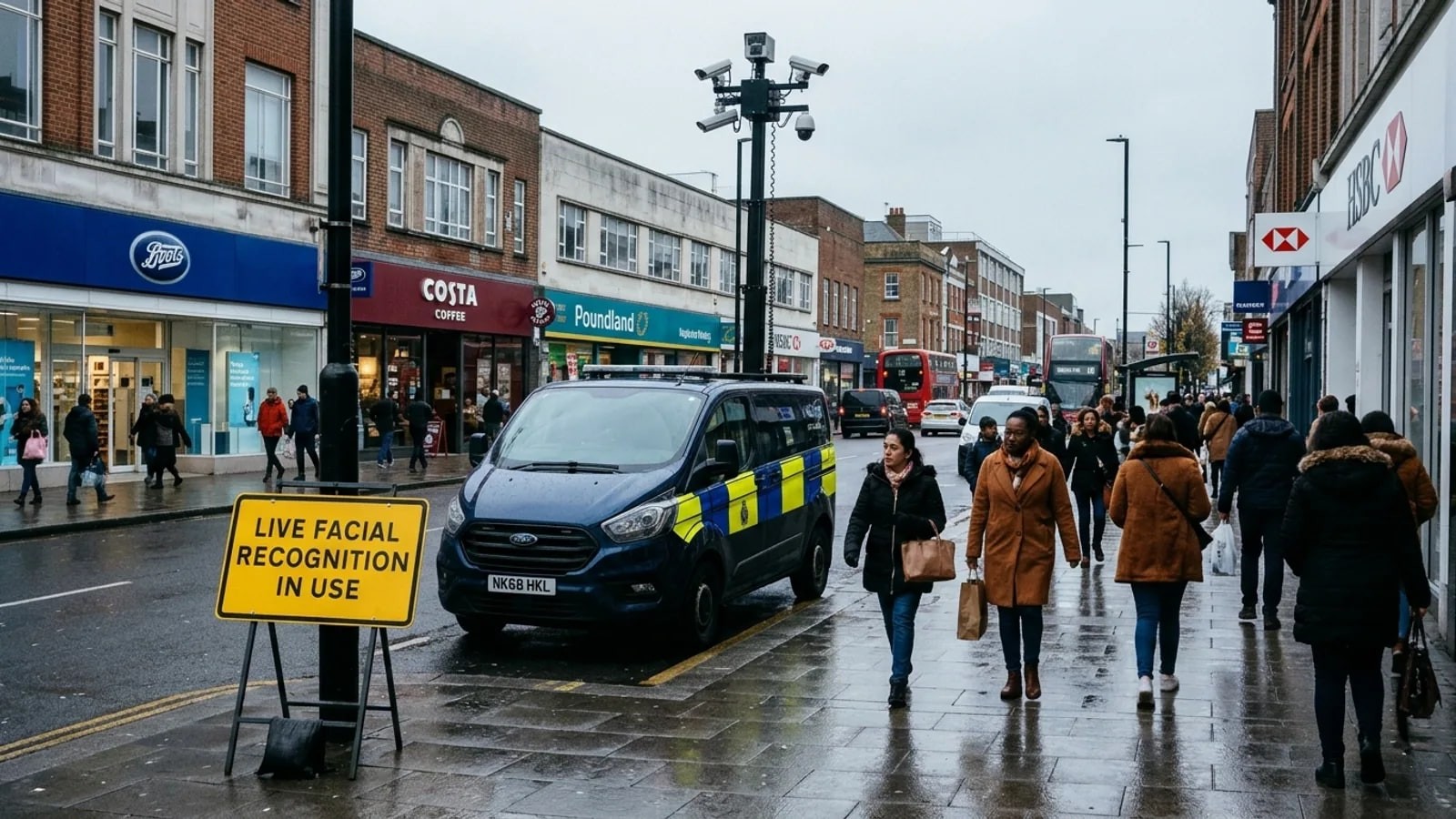
Live facial recognition (LFR) means cameras, often on a marked van, scan faces in a public place and compare each one with a watchlist of people police want. An officer checks any alert before anyone is stopped. Under the Met's policy, data from faces that don't match is "automatically and immediately deleted", says the High Court's April 2026 summary.
The Met's report for September 2024 to September 2025 linked LFR to 962 arrests across 203 deployments, with 10 false alerts, The Register reported.
What is the UK law on police facial recognition today?
In R (Bridges) v South Wales Police, on 11 August 2020, the Court of Appeal found the force's use unlawful. Officers had too much discretion over who went on a watchlist and where cameras went. The data protection impact assessment was flawed. And the force hadn't done all it reasonably could under the public sector equality duty (section 149 of the Equality Act 2010) to check the software for bias.
On 21 April 2026 the High Court dismissed a challenge to the Met's newer policy, brought by Shaun Thompson, who was wrongly matched to his brother in 2024, and Big Brother Watch director Silkie Carlo. The court's summary says the policy's set rules on watchlists and locations make it "materially different" from the one in Bridges.
Where does the Clearview AI case stand at the Court of Appeal?
Clearview isn't a police force, but its case decides how far UK data law reaches face search firms abroad. The ICO fined it £7.5 million in 2022. The First-tier Tribunal said the ICO lacked jurisdiction, but in October 2025 the Upper Tribunal upheld three of the ICO's four grounds and sent the case back.
The Court of Appeal heard Clearview's appeal from 19 to 21 October 2026, with Privacy International supporting the ICO. As of 13 November 2026, no judgment has been published, and the fine itself is still undecided.
What are your rights if police scan your face?
- Part 3 of the Data Protection Act 2018 gives you a right of access to data police use for law enforcement. The ICO's guidance lets police "neither confirm nor deny" where an answer could harm an investigation, so a watchlist question may get no clear reply.
- Complain about your data to the force's data protection officer first, then to the ICO.
- If you were stopped after a false alert, complain to the force or through the IOPC's form, which passes it to the force in England and Wales.
Our guide to face search law in the UK covers UK GDPR and biometric data. This is general information, not legal advice.
What should you watch next?
Watch for the bill text and the Clearview judgment. In the EU, regulators are weighing face recognition in smart glasses, and the Learn hub tracks the law by region.
A public-web face search is different: you upload a photo you already have and get public pages with a similar face, with no live camera, no watchlist and no name. FaceSearch works this way; it can't see private accounts, returns look-alikes and doesn't confirm who someone is, and our responsible use rules ban tracking people.
frequently asked
- Is live facial recognition legal in the UK right now?
- Yes, when a force has a clear policy. The Court of Appeal said a policy leaving officers free to choose watchlists and locations is unlawful, and the High Court later found the Met's current policy clear enough. Forces must still follow data protection and equality law.
- What happens to my face if I'm not on the watchlist?
- Under the Met's policy, the system deletes your biometric data at once when there's no match, and images of people who aren't matched are blurred. Other forces write their own policies, so check the force's facial recognition page for its rules.
- Will shops have to follow the new rules too?
- The Home Office has promised a separate code of practice for businesses, including shops, that use facial recognition against crime. Until then, a shop using face matching must follow UK GDPR. You can ask it for a copy of your data and complain to the ICO if it ignores you.
- facial recognition
- police
- uk
- clearview
- live facial recognition
Written by
The FaceSearch Team
Product & Research, FaceSearch
We build FaceSearch, the face search engine that shows where your photos appear on the public web.