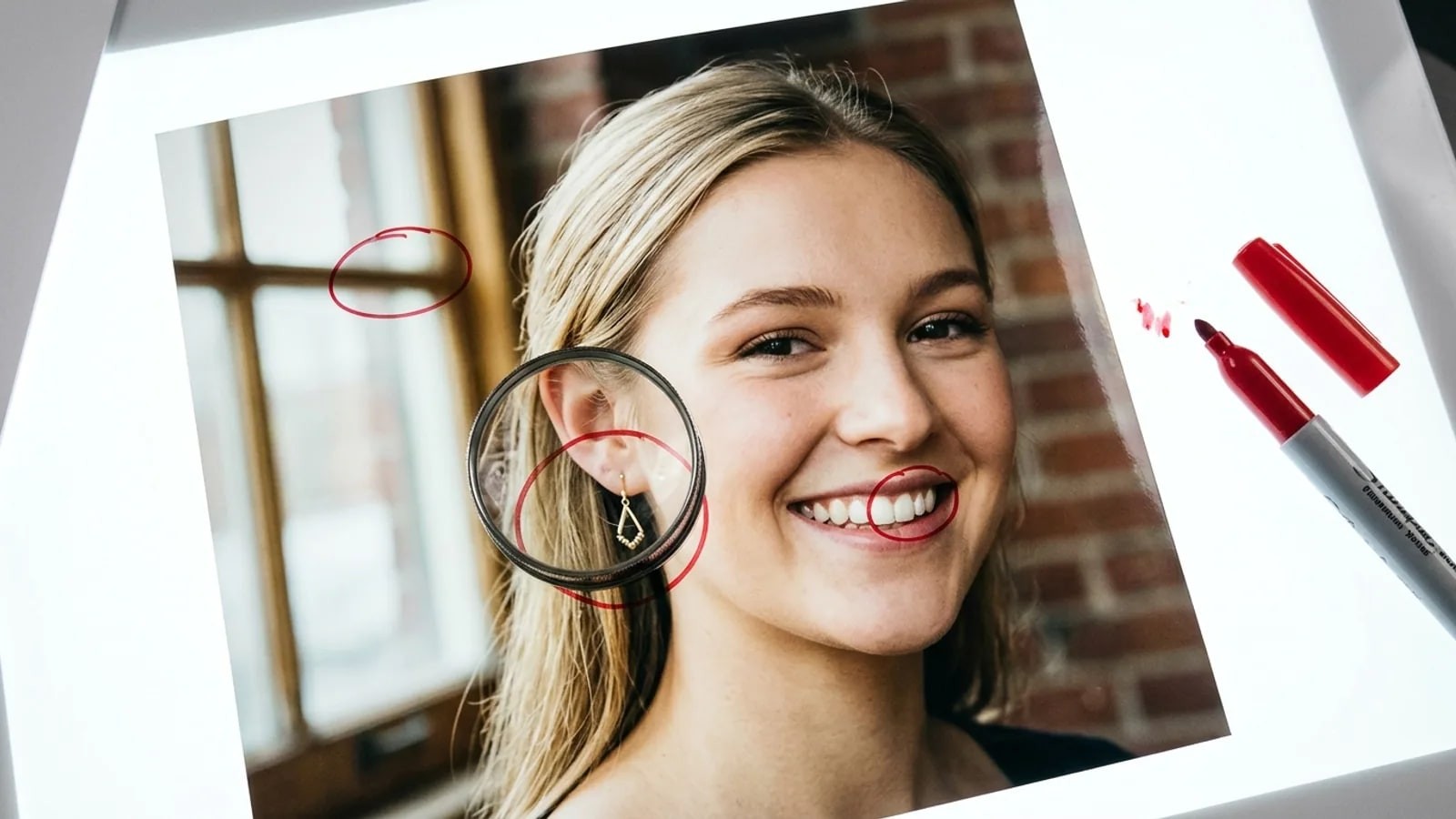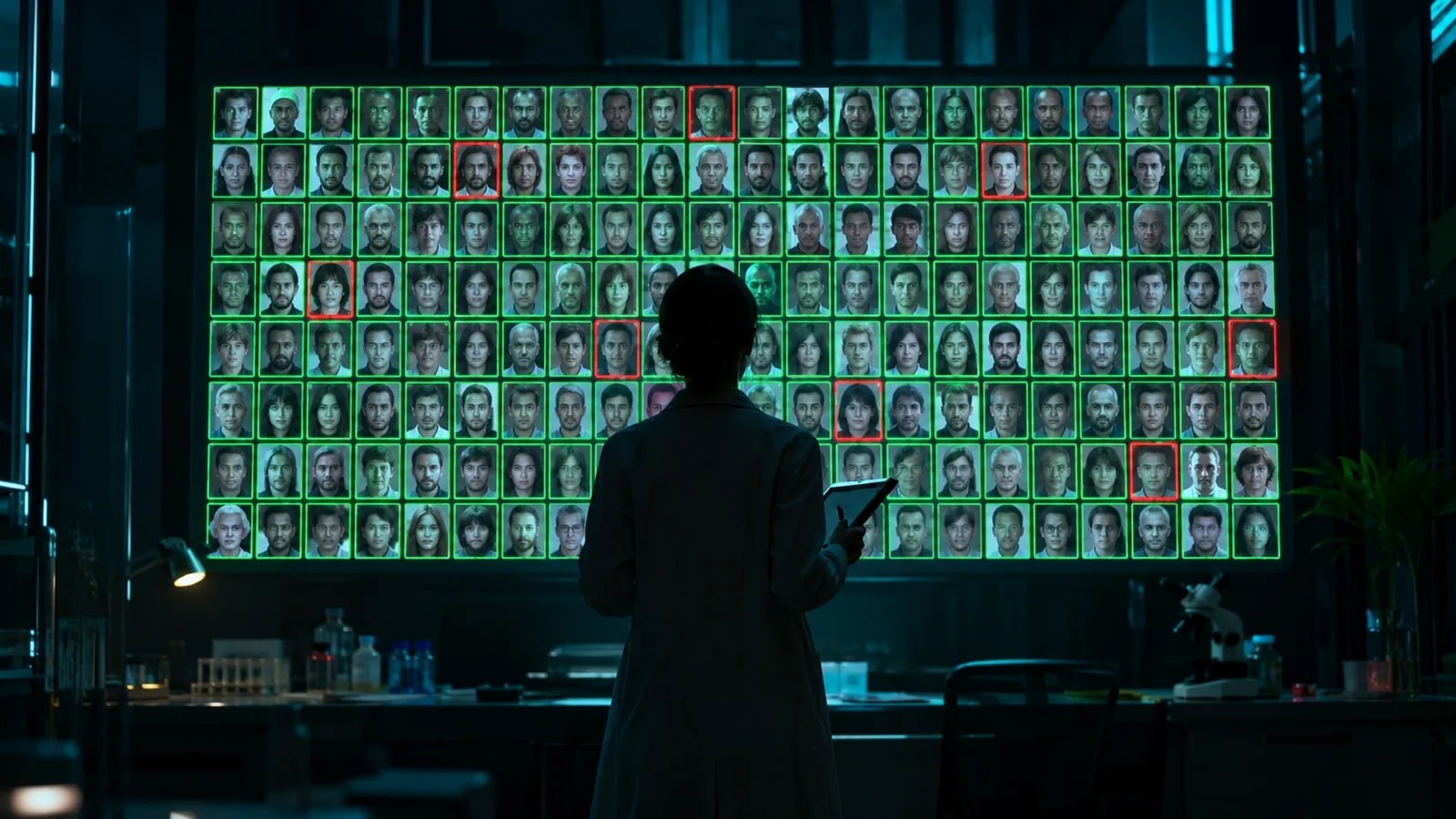
NIST tests hundreds of face recognition algorithms on passport and mugshot photos. What those scores mean, where they stop applying, and what the bias findings say.
- How accurate is facial recognition?
- On clear, front-facing photos, the best algorithms in NIST's ongoing tests make very few errors. That result does not carry over to every photo or every product. Accuracy depends on the algorithm, the threshold, image quality and who is in the picture, so a face match is always a lead, not proof of identity.
Most claims about facial recognition accuracy trace back to one source: the US National Institute of Standards and Technology (NIST). They are also narrower than the headlines that quote them.
What does NIST actually test?
NIST runs the Face Recognition Technology Evaluation, or FRTE. It used to be called the Face Recognition Vendor Test (FRVT), and NIST split and renamed it into FRTE and FATE (Face Analysis Technology Evaluation) on 18 August 2023. NIST's program page describes it as an ongoing activity that "runs continuously".
Developers send in their algorithms. NIST runs them on its own sequestered photo sets and publishes the results. The FRTE 1:1 page lists 1,501 algorithms from 461 developers submitted since 2017, as of its 6 November 2026 update.
The two main tracks answer different questions:
- Verification (one-to-one): do these two photos show the same person? Think of a phone checking your face before it opens, or a passport gate.
- Identification (one-to-many): does this face match anyone in a database of enrolled people, and who?
Our how face recognition works explainer covers the pipeline behind both, from face detection to embeddings, and the learn hub has more on the technology.
How does NIST measure facial recognition accuracy?
A face matcher gives every pair of faces a similarity score. A threshold turns that score into a yes or no. Two kinds of mistake follow, and NIST always reports them together.
The FRTE 1:1 page defines them. The false match rate (FMR) is the share of comparisons between two different people that score at or above the threshold. The false non-match rate (FNMR) is the share of comparisons of the same person that fall below it.
Moving the threshold trades one for the other. A strict threshold lets fewer strangers through and misses more genuine pairs. Per the FRTE 1:1 page, NIST picks the threshold that gives a fixed false match rate, such as one in 100,000 or one in a million, then reports how many genuine pairs each algorithm misses at that point.
The FRTE 1:N page uses matching terms for identification, plus an "investigation" mode with no threshold at all, where an algorithm returns a ranked list of candidates and "a human will be used to review the candidates."
A worked example
Say an algorithm is tuned to a false match rate of one in a million, the strictest level on the FRTE 1:1 leaderboard. For a phone that compares your face with one stored face, that is a tiny risk.
Now point the same algorithm at an index of 100 million faces. One in a million of 100 million is about 100 strangers who could clear the threshold on every search. The algorithm and its error rate haven't changed, only the number of faces it is compared against. That is why the size of the database matters as much as the false match rate.
How much has face recognition improved?
A lot, by NIST's own measure. In a November 2018 release, NIST said algorithms got 20 times better at searching a database for a matching photo between 2014 and 2018. In its 2018 test, 0.2 percent of searches failed, against about 4 percent in 2014.
The same release carried a warning from NIST's Patrick Grother: "There remains a very wide spread of capability across the industry." A headline about the best algorithm tells you nothing about the one inside a given app.
Why don't lab results carry over to web photos?
NIST tests on photos collected by government agencies. Its 2019 demographics report used domestic mugshots, immigration application photos, visa photos and border crossing photos, and NIST's release stresses they were not scraped from the internet.
Even inside that set, quality mattered. The report notes the border crossing photos fall short of capture standards, and false negatives behaved differently on them. NIST's demographics page says false negatives are "strongly dependent on image quality."
Web photos are harder still:
| Condition | NIST's main test photos | Typical photo on the web |
|---|---|---|
| Pose | Mostly front-facing, cooperative | Turned heads, tilted phones, profiles |
| Lighting | Controlled or standard | Backlit, night, harsh shade |
| Resolution | Full portrait | Thumbnails, crops, group shots |
| Editing | None | Filters, beauty modes, compression |
| Time between photos | Known | Anything from days to decades |
NIST does test some harder cases, such as mugshot pairs taken twelve or more years apart and border photos with heads turned 45 degrees or more, listed on the 1:1 leaderboard. The NISTIR 8280 summary advises system owners to measure accuracy "on the operational image data", because public test results can only inform them.
What did NIST find about face recognition bias?
NIST's December 2019 study, NISTIR 8280, ran 189 mostly commercial algorithms from 99 developers on 18.27 million images of 8.49 million people. Its main finding: false positive rates across demographic groups "often vary by factors of 10 to beyond 100 times." False negatives varied less, often by factors below 3.
The report found higher false positives for women than men, and for the elderly and children compared with middle-aged adults. On high-quality application photos, rates were highest for West and East African and East Asian people and lowest for Eastern Europeans, though several algorithms developed in China reversed the East Asian effect.
The picture was not uniform. NIST's summary says the most equitable algorithms "also rank among the most accurate," and the report adds that some identification algorithms showed false positive differentials too small to detect.
NIST kept tracking this. Its demographics page links a 2022 follow-up, NISTIR 8429, and an ongoing summary table last updated in March 2025. It explains that false positives "occur even with good image quality" and can come from under-representation of a group in training data.
Why does web face search show look-alikes?
Because similarity is not identity, and a web index is enormous. Twins make it plain: NIST's twins track states that many algorithms produce "high false match rates" on identical and same-sex fraternal twins.
Our page on the doppelgänger effect explains why look-alikes cluster lower in a result list and which photos make them worse.
Some common beliefs fall apart here:
- "It scored near-perfect in the lab, so a match means it's them." Lab figures come from a fixed threshold on clean photos. They say nothing about one match from a blurry web photo.
- "No match means the person isn't online." It means nothing in that index sat close enough. Private accounts, uncrawled pages and AI-made faces leave nothing to find, as our guide to spotting an AI-generated profile picture explains.
How should you read a face search result?
Treat every match as a lead and confirm it with things that are not the face. Open the source page. Check the name, the date, the place and the other photos on it. Several independent pages that agree are worth more than one strong thumbnail.
FaceSearch works within the same limits. It searches publicly accessible pages only, returns faces ranked by similarity with the page each was found on, and look-alikes appear. It never confirms who someone is, and it publishes no accuracy figure. Our results guide shows how to read the list, and the responsible use rules set out what searches are allowed.
frequently asked
- What is the difference between FRVT and FRTE?
- They are the same NIST program under two names. The older name was the Face Recognition Vendor Test (FRVT). NIST split it into FRTE, which covers recognition tasks such as verification and identification, and FATE, which covers face analysis such as quality, morphing and age estimation.
- Does NIST certify or approve facial recognition products?
- No. NIST's role here is testing. It measures algorithms that developers choose to submit and publishes the results. A good FRTE ranking applies to that exact algorithm on NIST's photo sets. It says nothing about the threshold a product sets or the photos it gets in real use.
- Is facial recognition less accurate for darker skin?
- NIST's demographic effects study (NISTIR 8280) found that many algorithms had higher false positive rates for some groups, including African and East Asian people, and that the size of the gap varied widely by algorithm. NIST also notes that poor lighting or exposure can raise false negatives for dark-skinned people, which is a photography problem as much as an algorithm one.
- facial recognition
- nist
- accuracy
- bias
- face search
Written by
The FaceSearch Team
Product & Research, FaceSearch
We build FaceSearch, the face search engine that shows where your photos appear on the public web.