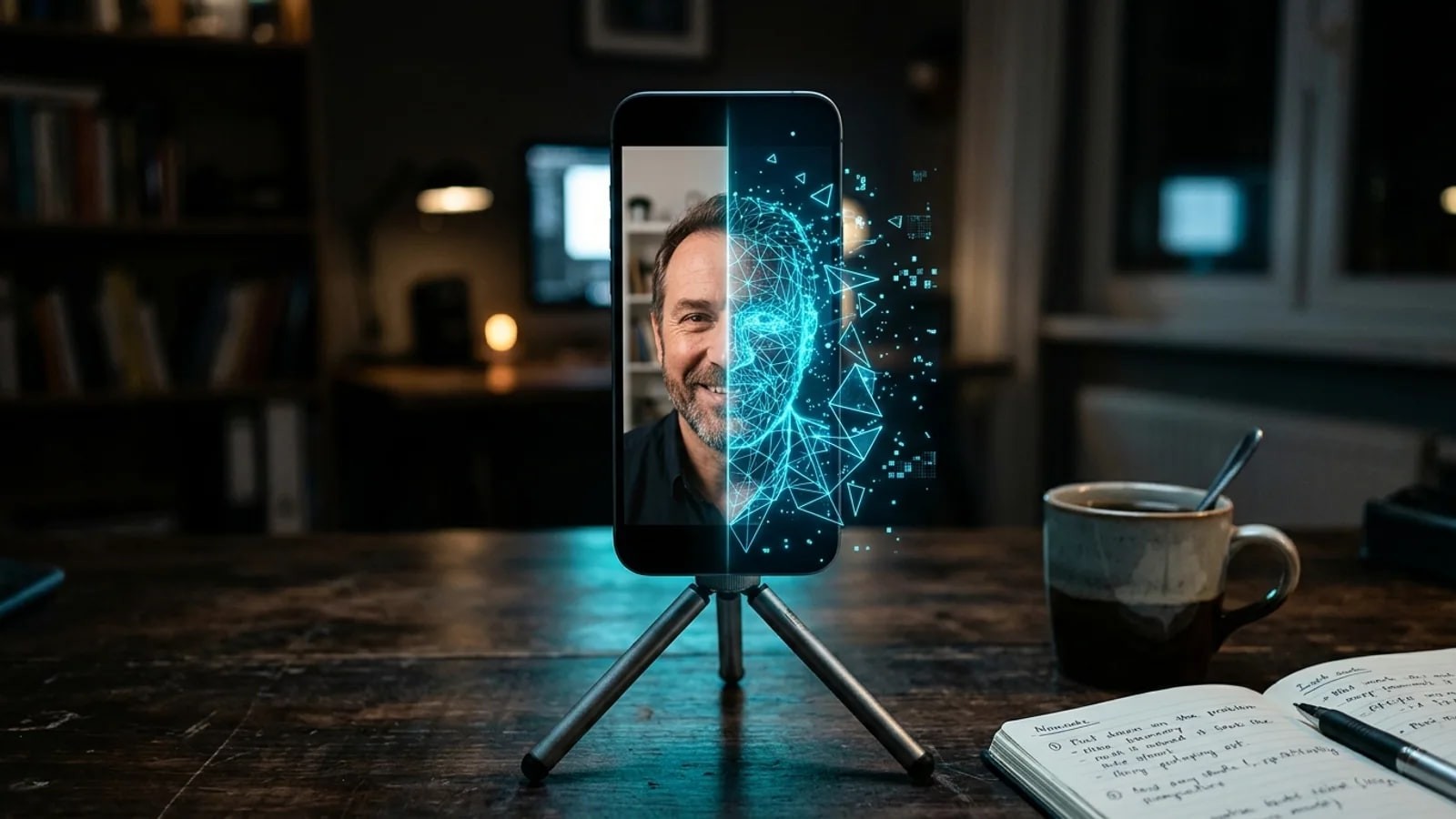
A familiar face on a live call is no longer proof. How scammers fake one, where the mask slips, and the four checks that work even when it doesn't.
- How do you spot a deepfake video call scam?
- Don't count on spotting glitches. A deepfake video call scam lays a familiar face over a scammer's own, live or recorded, then asks for money or secrecy. Ask for an action they can't plan, hang up and call back on a number you already have, ask for a code word, and check with a second person before paying.
In early 2024, a finance worker at engineering firm Arup's Hong Kong office joined a video call with people he believed were the company's chief financial officer and other staff. He sent HK$200 million, about US$25.6 million, in 15 transactions, CNN reported. Arup confirmed that "fake voices and images were used."
Most deepfake video call scams are smaller: a friend, a relative or an "officer" on WhatsApp who needs money now. The checks below work at every size.
How does a real-time deepfake scam work?
A face-swap tool finds the points of a face in each video frame (eyes, nose, mouth, jawline) and paints a different face over them, so the scammer's expressions drive someone else's features. It learns that face from photos and video, often taken from the public web.
The FBI's December 2024 warning says criminals generate videos "for real time video chats" with alleged company executives and law enforcement. Its July 2026 alert adds that scammers use publicly available photographs and AI-generated voices.
Many scams cheat. In the Arup case, Hong Kong police said the deepfake videos were pre-recorded and involved no dialogue with the victim, Hong Kong Free Press reported. A meeting where nobody talks with you is a warning sign in itself.
Some tools are crude. In July 2023, a 72-year-old in Kozhikode, Kerala, sent ₹40,000 after a WhatsApp video call from a "former colleague" that lasted about 30 seconds and showed only a close-up of the face, The News Minute reported. Kerala Police's cyber wing said the tool worked only with a blurred background and basic chin, eye and lip movement, PTI reported. Police blocked the money.
India's fake-officer calls are covered in our digital arrest scam guide.
How do you detect a deepfake on a video call?
A face swap learns mostly from front-facing photos in even light, so it slips when the real face does something unusual.
| Weak spot | Why it slips | What you might see |
|---|---|---|
| Profile turn | Few side-on photos to learn from | The face flattens or smears as the head turns |
| Hand or object in front | The tool loses the face points | The real face shows through, or a hand or cup melts into the cheek |
| Lighting change | The pasted face keeps its own lighting | A lamp switches on, the face stays evenly lit |
| Lag | Video and cloned voice run separately | Lips trail the words, or the face freezes while audio continues |
| Skin edges | The swap covers the face, not the neck | Tone changes at the jaw or hairline |
| "Bad connection" | Low resolution hides the flaws | A tiny, blurry close-up and a call that ends fast |
Hong Kong's computer emergency team, HKCERT, suggests asking the caller to slowly cover their face with a hand or move the camera onto another person, and checking whether the face matches the neck. The FBI's December 2025 alert lists "voice call lag time" and "unnatural movements".
Now the honest part. The same alert says AI content "is often difficult to identify." Each new tool closes some of these gaps. Treat a glitch as a reason to stop, but never treat a smooth call as a reason to pay. For still photos, see how to spot an AI-generated profile picture.
What are the four ways to break the illusion?
Spotting a fake depends on the tool's quality. These four checks don't. Use at least two before any money moves.
1. Ask for an action they can't plan
Ask them to turn their head fully to one side, slowly pass a hand across their face, then hold a mug near their cheek. Add something specific: "Show me the view from your window." A recorded clip can't do it, and a live swap often struggles.
2. Hang up and call back on a number you already have
Ring the person on the number saved in your phone, or the company's switchboard from its own website, never a number the caller gives you. The FBI says to independently identify a phone number and call. That is how the Kerala victim caught on: his colleague's real number reached a man who knew nothing.
3. Ask for the code word
Agree a secret word with family, and with whoever approves payments at work, before you need it. The FBI recommends this. Pick something that never appears online. A personal question works too, if the answer isn't on social media.
4. Check through a second channel or person
Message them on a different app, ask a colleague who sits near them, or require a second approver for urgent transfers. The Arup worker found out only after contacting head office, CNN reported. A request for secrecy is an attempt to block this step.
For the wider routine, see how to verify someone is real and our checklist for "is this person real?".
What should you do if you already paid?
Move fast: money still in transit is easier to stop.
- Call whoever moved the money. The FTC's advice for scam victims says to contact your bank, card issuer, wire company, gift card issuer or crypto exchange immediately, say it was fraud, and ask for a refund or reversal.
- Report it the same day (next section).
- Keep screenshots, the caller's number or username, chat logs and transaction IDs.
- Warn the real person whose face was used, through a channel you trust.
- Expect a second scam. The FBI's July 2026 alert warns of AI videos of a senior FBI leader used to lure victims, and says IC3 never asks for payment to recover lost funds.
Where do you report a deepfake video call scam?
Report the account on the app the call came through (WhatsApp, Zoom, Teams, Telegram), then to your country's fraud service. Details below were checked in November 2026.
| Country | Where to report |
|---|---|
| United States | ReportFraud.ftc.gov, and the FBI's IC3 if you lost money |
| United Kingdom | Report Fraud, which replaced Action Fraud: reportfraud.police.uk or 0300 123 2040 |
| India | The 1930 helpline or cybercrime.gov.in, run by I4C |
If you have a screenshot of the caller, FaceSearch can show whether that face appears on other public web pages, such as a real executive's profile or an account under another name, so you know whose face was borrowed. It does not detect deepfakes or tell whether a call was synthetic. It covers the public web only, look-alikes happen, and a match is not proof of identity. The deepfake and AI image check page explains the limits, and the use cases hub covers other situations. Check only someone who contacted you, per our responsible use rules.
frequently asked
- Can scammers really deepfake a face live on a video call?
- Yes. The FBI has warned that criminals make videos for live chats posing as executives and police. Quality varies a lot. Some calls are fully live, while others play a recorded clip and avoid any back-and-forth. Either way, the checks in this guide work because they don't depend on how good the fake looks.
- Are there apps that detect a deepfake during a call?
- Some business tools claim to, but none should be the only thing standing between you and a payment. Detectors miss new methods and sometimes flag real people. A call-back on a known number and a code word cost nothing and work against every version of the trick, including a perfect one.
- Can someone deepfake my face from my social media photos?
- They can, if enough clear photos or videos of your face are public. Executives, creators and anyone with many public clips are easier targets. Locking down old albums helps. So does agreeing a code word with family now, since your face is more likely to be used on them than on you.
- Should I tell the caller I think they're a deepfake?
- There's no need. Say you'll call back, end the call and use the number you already have. Accusing them only teaches the scammer which step failed. If it was really your boss or your relative, a call-back costs them a minute and they'll understand.
- deepfakes
- video call scams
- impersonation
- fraud
- 1930
Written by
The FaceSearch Team
Product & Research, FaceSearch
We build FaceSearch, the face search engine that shows where your photos appear on the public web.