No Indian agency arrests anyone on a video call. How the fake CBI and police script runs, why victims stay on camera for days, and what families can do first.
- What is a digital arrest scam, and what should you do?
- A digital arrest scam is a video call from people posing as CBI, ED, police, customs or TRAI officers who say you are linked to a crime and must stay on camera until you pay. It is fraud. No Indian agency arrests anyone by video call. Hang up, call 1930 and tell your family.
Digital arrest: what to do in the first 60 minutes
If you are on such a call now, or just got off one, do this in order.
- End the call. You are not under arrest. The Home Ministry's Indian Cyber Crime Coordination Centre (I4C) said so in its October 2024 advisory: CBI, police, customs, ED and judges do not arrest you on video call.
- Tell someone at home or call family. The scam depends on keeping you alone.
- If money moved, call 1930 now, the cyber fraud helpline on the National Cybercrime Reporting Portal. A fast report lets banks try to hold money not yet withdrawn.
- Call your bank with the transaction IDs.
- File a complaint on [cybercrime.gov.in](https://cybercrime.gov.in/) and keep the acknowledgement number.
- Send nothing more. Not a "refundable deposit", not a "clearance fee", not an OTP.
If you paid, you were not foolish. Organised teams run these calls all day, and they have fooled doctors and a business group chairman.
How does the digital arrest scam script work?
The details change, but most cases follow the same steps.
- The hook. A call says a parcel in your name holds drugs or fake passports, or that your SIM or Aadhaar was used in a crime. Some open with a "TRAI" warning that your number will be cut off.
- The handover. You are "connected" to a CBI, ED, police or customs officer, usually on WhatsApp or Skype video.
- The case. They show an FIR, an arrest warrant or a court order, all forged, and name a serious charge such as money laundering.
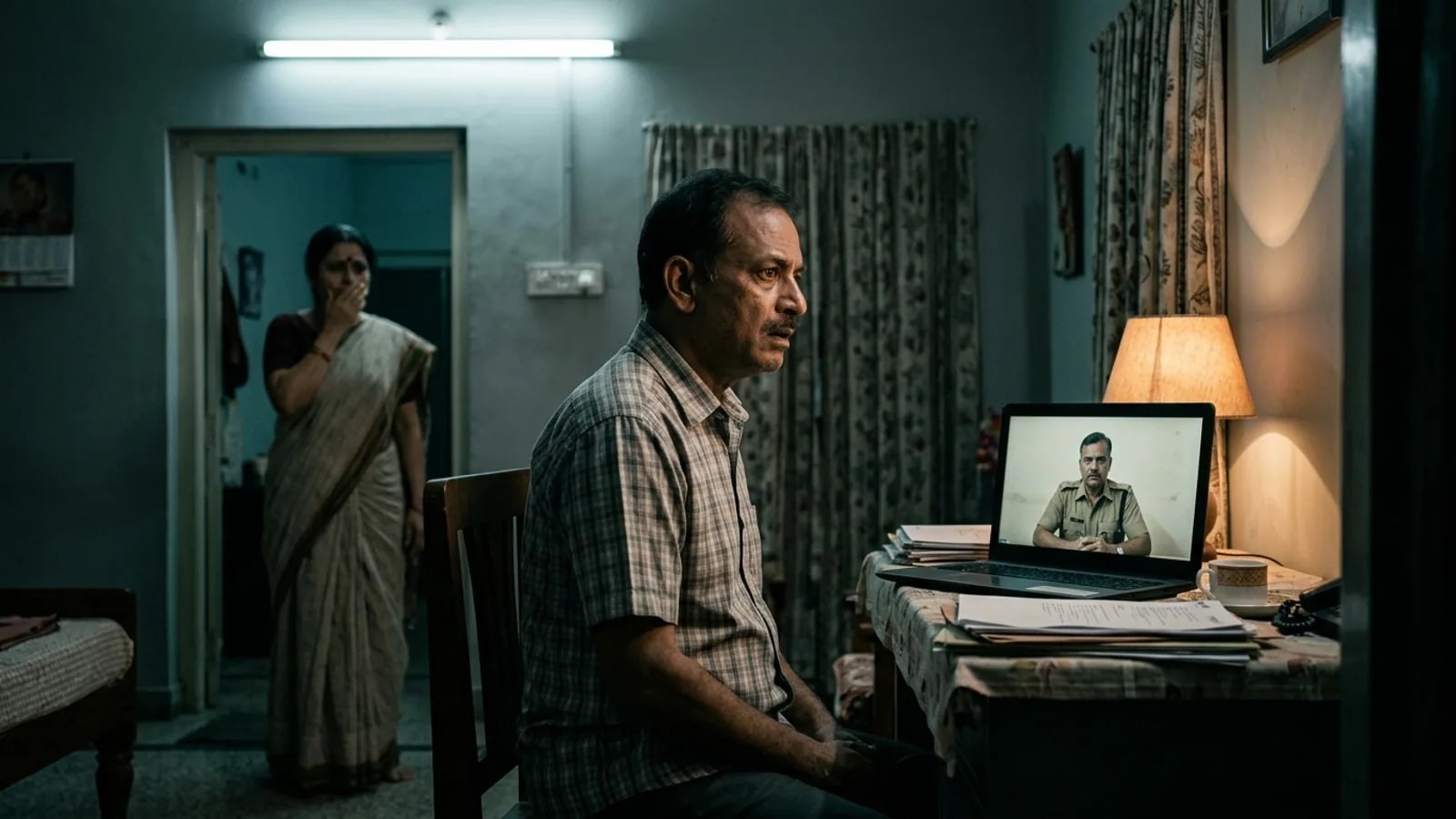
- The isolation. You must stay on camera, often for days, and tell no one because it is a "secret national security matter".
- The money. To prove your innocence, you move savings to a "safe" or "supervision" account for "verification", with a promise of refund.
The Supreme Court noted the use of forged court orders when it took up the issue on its own in October 2025, and in December 2025 it ordered the CBI to investigate these scams across the country.
What it has cost real people
In August 2024, Vardhman Group chairman S P Oswal was told a parcel to Malaysia with 58 fake passports was linked to his Aadhaar, PTI reported in ThePrint. Fake CBI officers staged a Supreme Court hearing and sent a forged warrant on WhatsApp. He paid ₹7 crore. His manager alerted police, who recovered ₹5.25 crore.
A doctor couple in Delhi's Greater Kailash lost ₹14.85 crore between 24 December 2025 and 9 January 2026, The Week reported. The first caller claimed to be from TRAI. Then a uniformed man appeared on video before "Colaba Police" banners.
In September 2026, the CBI said it had arrested eight people in three cases worth over ₹42 crore, where victims were held for one to three months, according to PTI.
Is the officer on a CBI video call scam real, or a deepfake?
Usually neither. In most reported cases the "officer" is a scammer in a costume uniform, in a set dressed as a police station.
AI fakes are the next layer. In August 2026, Kerala Police registered a case over a Facebook video in which the face and voice of a senior officer, ADGP P Vijayan, had been altered to promote a scam, PTI reported. A familiar face on screen proves nothing.
Nor does the phone number. Calls from abroad get disguised as Indian numbers. A Department of Telecommunications system that blocks them stopped about 1.35 crore in its first 24 hours, News On AIR reported in October 2024, naming fake digital arrests among the frauds.
If the "officer" sent an ID card photo, FaceSearch can show whether that face appears on other public web pages, for example under another name. It covers public pages only, a match is not proof of identity, and no result proves nothing. Our page on how to verify someone is real and our post on whether a person is real explain why other checks count more. Here you need no photo check at all: the demand is the proof.
How common are digital arrest scams in India?
In the Mann Ki Baat broadcast of 27 October 2024, the Prime Minister said "There is no system like digital arrest in the law" and urged people to "Stop, then think, and then take action".
The numbers differ by source. I4C data seen by ThePrint shows 1,23,672 cases and ₹1,918 crore lost in 2024, falling to 17,264 cases and ₹644 crore in 2025. A Home Ministry reply in the Rajya Sabha put 2024 losses at ₹1,935.51 crore, Inc42 reported. Fewer cases has not meant small ones, as the 2026 cases show.
What are the red flags of a fake police video call?
Any one of these is enough to hang up.
- An officer says you are under arrest, or "digital arrest", over a phone or video call.
- You are told to stay on camera, keep the door shut, or not tell family.
- A court hearing, warrant or "RBI letter" arrives on WhatsApp.
- You are asked to move money to "verify" it, or to a "safe" account.
- A TRAI or courier call quickly hands you to "police" or "CBI".
- The caller knows your Aadhaar number or address. That data leaks often and proves nothing.
How do you report a digital arrest and what evidence should you keep?
Collect evidence before you block anyone. The PM's broadcast advised taking screenshots and recordings where possible.
- Caller numbers, WhatsApp or Skype IDs, and screenshots of each profile
- Screen recordings or photos of the video call, if you can take them safely
- The fake FIR, warrant or court order as received, with the chat around it
- Bank or UPI transaction IDs, account numbers and times
Then report:
| What happened | Where to report |
|---|---|
| You lost money or shared bank details | Call 1930 now, then file on cybercrime.gov.in |
| You got a call but did not pay | Report the number on Chakshu at Sanchar Saathi |
| You need an FIR | Take your portal acknowledgement number to the local cyber cell |
In August 2026 the Supreme Court gave the RBI four weeks to adopt a standard process for banks to place temporary holds on accounts linked to cyber fraud, LiveLaw reported. The faster you report, the more there is to hold.
How can families protect elderly parents?
Several of the largest reported losses, including the Delhi case above, involved older people at home. A short talk does more than any app.
- Tell them: "Police never arrest anyone on a video call. If someone says so, hang up and call me."
- Agree that any call about arrest, parcels or money laundering gets one family call first.
- Turn on transaction alerts and ask the bank about a daily transfer limit.
- Save 1930, the helpline on the cybercrime portal, in their phone.
- Call more often if they live alone. Scammers rely on nobody noticing for days.
Our use cases hub has more checks for situations where you are unsure who you are dealing with.
frequently asked
- Will I get my money back after a digital arrest scam?
- Sometimes, partly. Money frozen in the receiving accounts before it is withdrawn can be returned through the bank and court process, which is why the first hour matters. Money moved through many accounts or withdrawn as cash is much harder to trace. Report anyway, because each complaint helps police link accounts across cases.
- What if the scammers call back after I hang up?
- Expect it. They may call from a new number, sound angrier, or claim a "senior officer" is coming to your house. Do not answer unknown numbers for a few days or reply to messages. If real police ever need you, you can confirm it in person at your local police station.
- Could I be in trouble for the money I transferred?
- No. Being tricked into paying is not a crime, and the people who called you are the ones the police want. Some victims stay quiet out of embarrassment or fear of a real case, which only helps the scammers. Report it with every detail, including what you were told to hide.
- digital arrest
- india
- cbi video call scam
- 1930
- cyber fraud
Written by
The FaceSearch Team
Product & Research, FaceSearch
We build FaceSearch, the face search engine that shows where your photos appear on the public web.