From the wrong number text to the fake recovery lawyer, the stages romance scammers repeat, the lines regulators have recorded, and the moment a photo check helps most.
- What is the romance scam script?
- It is the rehearsed order most romance scammers follow: a friendly or "wrong number" opener, fast affection, a move to a private app, a backstory that rules out meeting, a small test request, then a crisis or investment pitch paid in ways that are hard to reverse. Check the photos early, before any money moves.
Romance scammers do not improvise much. The same romance scam script turns up in report after report. Below are the stages, the lines regulators and AARP have recorded at each one, what is behind them, and the point where checking a photo does the most good. If any of these lines worked on you, the script did what it was built to do.
What is a romance scam script?
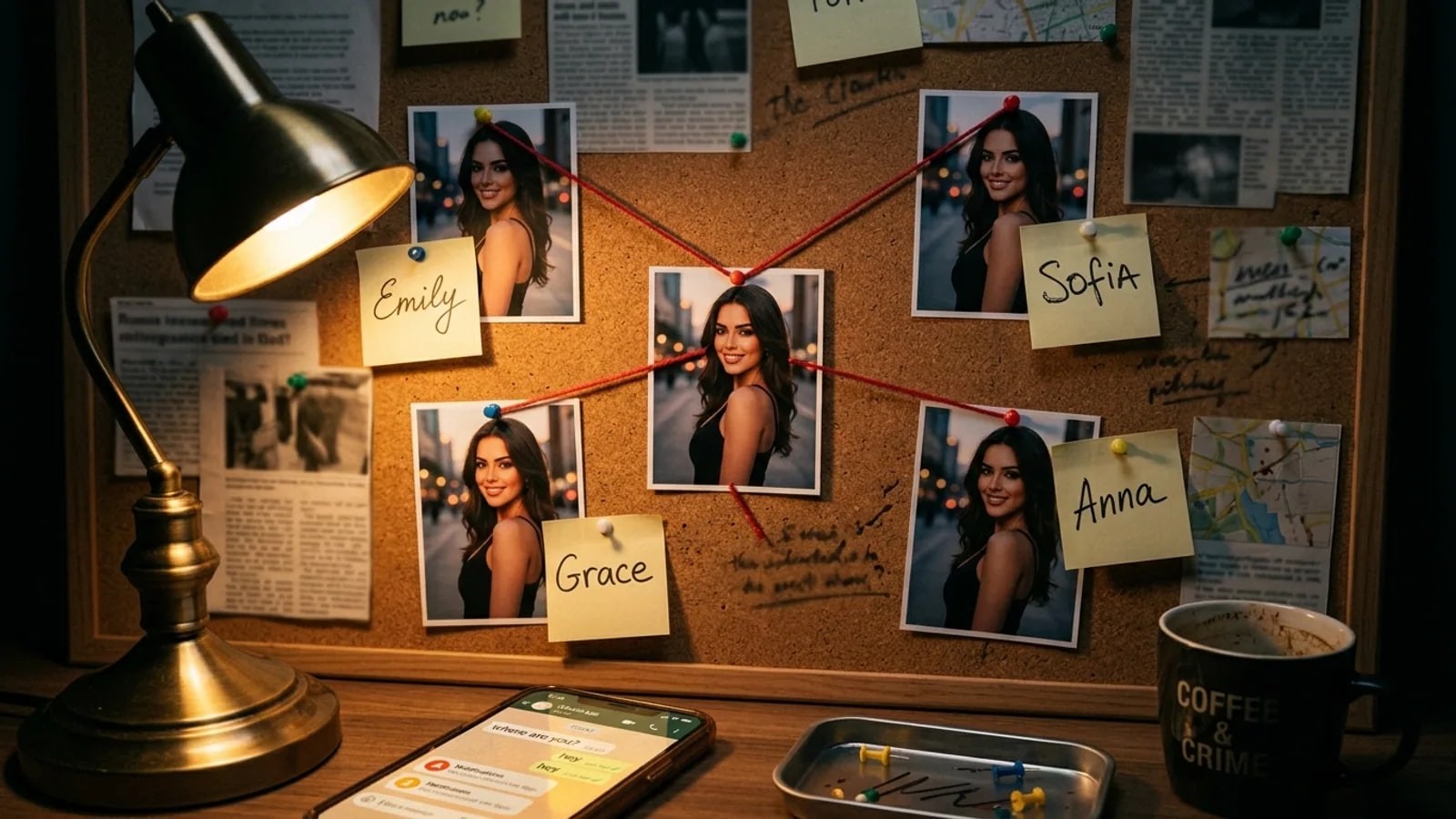
A playbook that gets reused. The Better Business Bureau's romance scam study found that scammers "reuse successful scripts": build a profile, groom the target, take the money, then come back after the target finds out.
The FBI's 2025 Internet Crime Report adds that romance scammers now use "scripts produced by AI chat generators", so the messages read smoother. The order of the stages has not changed.
Romance scammer phrases, stage by stage
The quoted lines are examples published by the FTC, FBI, AARP, BBB or US Army. Wording varies, so watch the move behind it.
First contact: the wrong number or the friendly message
Example from the FTC: "When are you free for coffee?" The FTC says wrong number texts "often evolve into a conversation with romantic undertones that can lead to investment and other scams."
What's going on: these messages go out in bulk. Replying, even to say "wrong number", tells the sender your number works, per the FTC.
Mirroring and love bombing
Examples AARP has quoted: "We'll travel" and "We're a team." In one case AARP reported, the scammer wrote: "I can only see my future with you. I will never stop loving you."
What's going on: this is love bombing, which AARP describes as "excessive or abnormally effusive displays of adoration and attention". Tastes that echo your posts are often mirroring. The goal is trust before you have facts.
Moving off the app
Example from an expert quoted by AARP: "They want to take you off those sites."
What's going on: a dating app can read reports and ban the account. The BBB study notes that once the dating profile is gone, the scammer can still reach you.
The backstory that rules out meeting
The FTC lists the usual stories: living or traveling abroad, on an oil rig, in the military, with an international organization. The AARP case involved a "surgeon" from Norway, supposedly working for the UN in Iraq. Fake soldiers often say they "cannot speak to you on the phone", per Army CID.
What's going on: each detail explains in advance why there will be no video call or visit, and later why money is needed.
The test request
The BBB study describes one scammer who "asked for small sums of money for supposed minor emergencies to test his influence". One reader told the FTC about a "doctor" who kept asking for a $200 Apple gift card for his daughter.
What's going on: a small ask shows whether you will comply, and saying yes once makes the bigger ask feel normal.
The crisis or the investment pivot
Examples from the FTC: money for a plane ticket to visit, emergency surgery, a visa. AARP sums up the crisis line as: they need cash fast and "you're the only one who can help."
The investment version sounds kinder: "Let me show you how I'm making money," in AARP Washington's account, then screenshots of gains, a trading site and pressure to add more. Withdrawals never arrive. Our romance scam statistics post shows how much money now moves this way.
The payment method switch
The FTC lists the asks: wire transfers through Western Union or MoneyGram, gift card PIN codes, money transfer apps and crypto. Its shortest advice: "Only scammers tell you to pay those ways" (FTC alert).
What's going on: these payments are hard to reverse. Some are also asked to receive and forward money, which the BBB says can turn victims into money mules without their knowing.
The recovery scam
After the loss, a "lawyer" or "FBI agent" offers to get your money back for a fee. The FBI's June 2024 alert says fake law firms claim an agency shared your case with them; victims reported over $9.9 million lost to them from February 2023 to February 2024.
What's going on: scammers target people they know have already paid. The FBI's July 2026 alert is blunt: "IC3 will never ask for payment to recover lost funds."
When should you check the photos?
Right after the move off the app and the story about why you can't meet, and before any test request. Nothing has been paid yet, and the photos are usually borrowed from a real person whose pictures are public somewhere. Both the FTC and AARP advise a reverse image search of the profile picture.
| Stage you're at | Romance scam red flags in 2026 | What to do |
|---|---|---|
| Opener, love bombing | Stranger, fast affection | Slow down, stay on the app |
| Off the app, backstory | Can't meet, no video | Check the photos now |
| Test request | Small ask, small favor | Say no, ask for a live video call |
| Crisis or investment | Urgency, profits, secrecy | Stop, tell someone, send nothing |
| Recovery offer | Fee to get money back | Ignore, report it |
The romance scam photo check walks through the steps. FaceSearch is one tool for it: it matches the face itself, so it can find cropped or filtered copies of stolen photos on public pages. It cannot see private accounts or chats, does not tell you who anyone is, and can return look-alikes. An AI-generated face has no original, so an empty result proves nothing; the signs of a catfish post covers those tells. Use a search only to check the person talking to you, as our responsible use page sets out.
How do you step back without escalating?
Confronting a scammer tends to bring guilt trips, threats or a second "helper".
- Don't reply to unexpected texts. The FTC suggests forwarding them to 7726 (SPAM) and deleting them (FTC).
- Ask for a live video call in a neutral way, without saying what you suspect.
- Test the story quietly. Search their job plus the word "scammer", as the FTC suggests. For a "soldier", Army CID suggests asking for an email from a .mil address.
- Tell one person you trust. AARP says experts see this as the best way to avoid fraud.
- If the photos or the story fall apart, take screenshots, stop contact and report the profile on the app.
What if you already sent money?
It happens to careful people every day, because the script is built to work. Speed matters now more than anything else.
- Call your bank or the payment company today. The FTC says to tell them you paid a scammer and ask for a refund.
- Stop all payments, including "fees" to release a withdrawal.
- Save everything: profile, chats, receipts, trading site links.
- Report it. The FBI's 2025 report says its Recovery Asset Team can help most when complaints are filed quickly.
| Where you are | Where to report |
|---|---|
| United States | ReportFraud.ftc.gov and the FBI's IC3 |
| England, Wales and Northern Ireland | Report Fraud, 0300 123 2040 (per Which?); Scotland: Police Scotland on 101 |
| India | Call 1930 or file at cybercrime.gov.in (PIB) |
| Anywhere else | Local police and the platform where you met |
More checks for dating and money scams are on the use cases hub.
frequently asked
- Why do they ask me to keep the relationship secret?
- Because the people who know you are the most likely to spot the script. AARP calls a request for secrecy a major red flag, and the FBI notes that scammers urge victims not to tell anyone. If you feel you cannot mention this person to a friend, treat that feeling as the warning.
- Can a scammer use their own real photos?
- Sometimes. If the face shows up under the same name on their own public accounts, the photos are probably theirs. That says nothing about the money request. Any ask for gift cards, crypto or a wire from someone you have never met in person is a reason to stop, whoever is in the picture.
- What if they threaten me after I stop replying?
- Do not pay or reply. Save the messages, block the account and report it. The FBI warns that some victims who go quiet are then contacted by fake police officers demanding money. Real police do not charge fees or ask for gift cards or crypto.
- romance scams
- scam scripts
- dating safety
- love bombing
- recovery scams
Written by
The FaceSearch Team
Product & Research, FaceSearch
We build FaceSearch, the face search engine that shows where your photos appear on the public web.