The FBI logged $929 million in romance and confidence fraud losses for 2025, up 38%. Who lost the most, how the money moved, and why the photos give these scams away.
- What do the latest romance scam statistics show?
- The FBI's 2025 Internet Crime Report counted 23,159 confidence and romance fraud complaints with $929.3 million in losses, up 38% on 2024. The FTC says reported romance losses rose 22%. People 60 and over carried most of the FBI total, and about 42% of the losses involved cryptocurrency.
These are the romance scam statistics for 2026, built from the 2025 figures the FBI and the Federal Trade Commission published this year. The numbers come from people who chose to report, so the real total is higher. Below: the headline figures, who loses the most, how the money moves, and the stolen-photo trick that keeps the whole thing running.
Romance scam statistics 2026: the headline numbers
Two federal agencies count romance scams, and they count differently. The FBI's Internet Crime Complaint Center (IC3) takes complaints at ic3.gov. The FTC collects reports through ReportFraud.ftc.gov and, per its March 2026 testimony, nearly 180 other data sources into a database called Consumer Sentinel.
The FBI's 2025 Internet Crime Report logged 23,159 confidence and romance complaints and $929,287,469 in reported losses. That makes it the fourth costliest of the cyber-enabled fraud types in the report, behind investment fraud, business email compromise and tech support scams.
One detail matters when you quote it. The FBI's "Confidence/Romance" category also covers grandparent scams and other fake family or friend relationships, so it is not romance alone.
The FTC has not yet published a full 2025 Consumer Sentinel Data Book: as of November 2026, the reports page still lists 2024 as the latest. Its May 2026 consumer alert says reported romance losses rose 22% in 2025. The dollar total printed there reads "$1.48 million", which looks like a typo, so we leave it out until the Data Book confirms the figure.
| Measure (2025) | Figure | Source |
|---|---|---|
| Confidence/romance complaints | 23,159 | FBI IC3 2025 report |
| Confidence/romance losses | $929,287,469 | FBI IC3 2025 report |
| Change in reported romance losses | up 22% | FTC consumer alert, May 2026 |
| Romance losses that started on social media | $298 million | FTC Data Spotlight, April 2026 |
For scale, the FTC told Congress in March 2026 testimony that it received 3 million fraud reports in 2025, with $15.9 billion in reported losses across every scam type, and that not every victim reports.
Who loses the most to romance scams?
Older Americans, by a wide margin. In the IC3 report, people 60 and over filed 10,188 confidence and romance complaints and reported $584,032,745 in losses. That is about 63% of the category's total, from fewer than half of its complaints.
| Age group | Complaints | Reported losses |
|---|---|---|
| Under 20 | 393 | $3,057,718 |
| 20 to 29 | 1,886 | $25,097,693 |
| 30 to 39 | 2,501 | $42,460,967 |
| 40 to 49 | 3,010 | $74,644,395 |
| 50 to 59 | 3,745 | $131,385,454 |
| 60 and over | 10,188 | $584,032,745 |
Source: FBI IC3 2025 Internet Crime Report, crime types by age group and elder fraud section. Not every complaint gives an age, so the rows add up to less than the total.
Divide the IC3 losses by the complaints and the gap gets sharper. A complaint from someone 60 or older averaged about $57,000. One from someone in their twenties averaged about $13,000.
The FTC sees the same pattern from a different angle. Its October 2026 report on older consumers found that, after controlling for population size, adults 60 and over were 48% more likely than younger people to report losing money on a romance scam. It also says six-figure losses among older adults were often about investment, romance and impersonation scams.
Younger people are not safe from this. They just tend to report smaller losses, and they meet the same scripts on the same apps.
How does the money move in a romance scam?
Mostly through payments that are hard to pull back. The FTC's romance scam advice lists the usual asks: wire transfers through a company like Western Union or MoneyGram, gift cards with the PIN codes read out, money transfer apps, and cryptocurrency.
Cryptocurrency. The IC3 report counted 5,925 confidence and romance complaints with a crypto link, carrying $394,787,515 in losses. That is about a quarter of the complaints but about 42% of the money. This is where romance turns into a fake investment: the partner shows you a trading site, your balance climbs on screen, and the withdrawals never arrive.
Gift cards. Smaller sums, many times over. The FTC's older consumers report says gift cards were the payment method older adults reported most often on romance scams in 2025.
Bank transfers and wires. The same FTC report names bank transfers and cryptocurrency as the costliest payment methods for older adults overall, measured by total dollars lost.
The pattern is simple. Small, frequent payments go by gift card. The life-changing losses go by wire or crypto, usually after months of trust.
What changed from 2024 to 2025?
After two flat years, the numbers jumped. The FBI's three-year tables show it clearly.
| Confidence/romance (FBI IC3) | 2023 | 2024 | 2025 |
|---|---|---|---|
| Complaints, all ages | 17,823 | 17,910 | 23,159 |
| Losses, all ages | $652,544,805 | $672,009,052 | $929,287,469 |
| Complaints, 60 and over | 6,740 | 7,626 | 10,188 |
| Losses, 60 and over | $356,888,968 | $389,312,356 | $584,032,745 |
Source: FBI IC3 2025 Internet Crime Report, three-year comparison tables.
In the IC3 figures, complaints rose 29% and losses 38% in a year, after growing about 3% from 2023 to 2024. Losses reported by people 60 and over rose 50%. The FTC's figure for romance losses, a 22% rise, is smaller but points the same way. The two agencies collect different reports, so both can be right.
Two other shifts stand out:
- Social media is now the usual starting point. The FTC's April 2026 Data Spotlight says nearly 60% of people who lost money to a romance scam in 2025 said it began on a social media platform, not a dating app.
- AI has entered the count. For the first time the IC3 report puts a figure on it: over $19 million lost to confidence and romance scams with a likely AI link, using "fake profiles and scripts produced by AI chat generators".
Why do stolen photos sit behind so many romance scams?
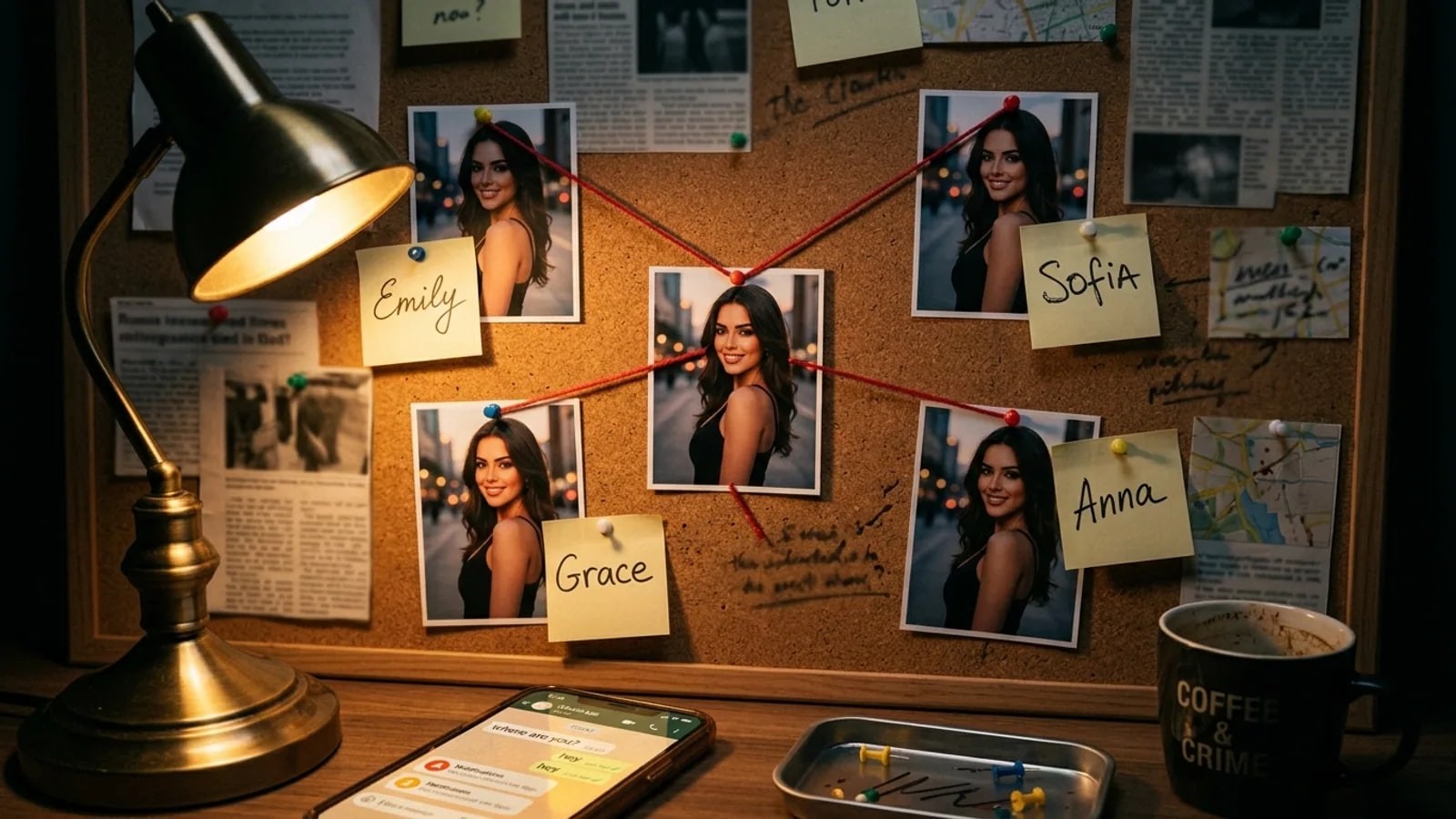
Because the story can be made up, but the face has to look real. A scammer needs pictures of a trustworthy, attractive person who seems to have a life: a soldier in uniform, a doctor in scrubs, a widower with a dog. They lift these from public pages, then reuse one set of photos across many profiles under many names.
The FTC's own advice is to run a reverse image search on the profile picture. If the same face turns up under a different name, or with details that do not match the story, you have your answer. The person in the photos is usually a victim too, and has no idea their face is being used.
This check has limits. An AI-generated face has no original online, so a search can come back empty. A cropped or filtered copy can slip past a normal image search, which looks for the same file rather than the same face. Our post on the signs of a catfish covers the visual tells of AI photos and the live video test that a fake cannot pass easily.
The romance scam photo check walks through it step by step. FaceSearch is one way to run it: it matches the face itself, so it can find cropped or filtered copies of the same photos on public pages. It cannot see private accounts or chats, does not tell you who someone is, and can return look-alikes. No match does not prove the person is real. Use it to check someone who is talking to you, never to track down a stranger; our responsible use page sets out the rules.
What should you do if you think you are in a romance scam?
- Stop sending money. No gift cards, crypto, wires or documents, whatever the deadline.
- Call your bank or the payment company today. The FTC says to contact them right away and ask for a refund or reversal.
- Keep everything. Screenshot the profile, the chats, the payment requests and any trading site.
- Report to both agencies. File at ReportFraud.ftc.gov and at the FBI's IC3. The IC3 report notes its Recovery Asset Team can help most when complaints are filed as quickly as possible.
- Report the profile on the app or social network where you met.
Every report also feeds the next year's numbers, which is how the figures in this post exist at all. More checks for dating and money scams are on the use cases hub.
frequently asked
- Are romance scam losses really higher than the reports show?
- Almost certainly. Both counts depend on people choosing to file, and many victims feel embarrassed or never realize they were scammed. The FTC told Congress that not every victim reports. Treat the FBI and FTC totals as a floor, not a full measure of what romance scams cost.
- Why do the FBI and FTC numbers differ?
- They collect different reports. The FBI counts complaints filed with IC3 and groups romance with other relationship frauds such as grandparent scams. The FTC counts reports in Consumer Sentinel from consumers and partner organizations. Some people report to both and many report to only one, so each agency sees part of the picture.
- Will I get my money back if I report?
- Not always, but speed improves your chances. Call your bank or payment company first, since a wire or card payment can sometimes be stopped or recalled. Then file with IC3 and the FTC. Be wary of anyone who contacts you offering to recover your losses for a fee; that is a common second scam.
- Do men or women lose more to romance scams?
- Neither the FBI nor the FTC figures used here break romance losses down by gender, so there is no official answer for 2025. The figures they do publish show age as the clearer divide, with people 60 and over reporting the largest losses.
- romance scams
- scam statistics
- fbi ic3
- ftc
- older adults
- dating safety
Written by
The FaceSearch Team
Product & Research, FaceSearch
We build FaceSearch, the face search engine that shows where your photos appear on the public web.